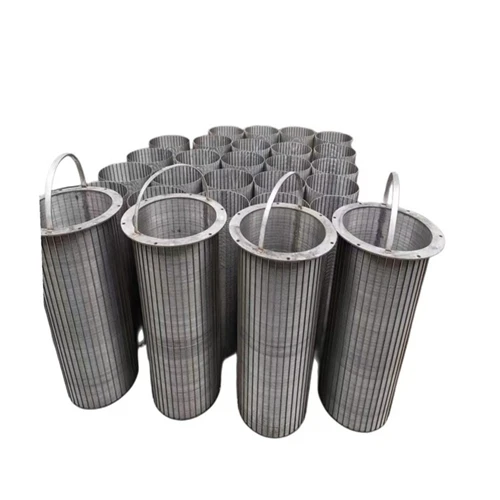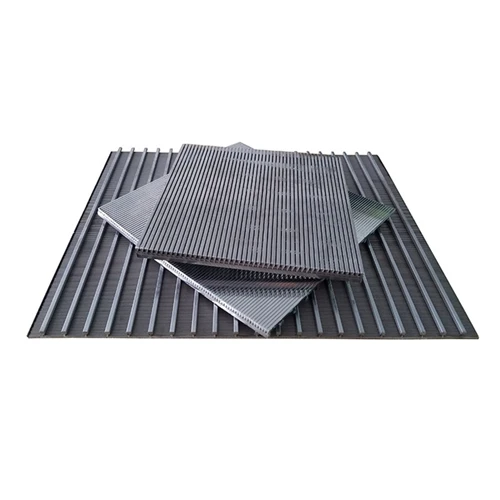
Walk through an old coal washing plant and you will see woven mesh or punched plate on the screens. Both blind out fast once fine slurry builds. Wedge wire sieve plates flip that geometry. Each slot is a continuous gap between two triangular wires, narrow on top and wider underneath. Fine particles that do not pass fall away instead of wedging, so the deck keeps draining long after woven mesh would need pulling.
On a dewatering screen, slope and slot work as a pair. A 0.5–1 mm slot on an inclined panel drains surface water while holding the coal back. For sizing, tighter 0.25–0.5 mm slots make the cut. Panels bolt to the vibrating frame; when one wears, swap just that one - the rest of the deck keeps running through the shift.
Pick the material carefully. 304 stainless is fine for normal slurry, but where chloride or acid spray is in the air, plants step up to 316L. On abrasive duty, welded panels outlast rubber-capped wire. For an operator counting downtime, longer panel life and fewer blindings usually pay back the higher upfront cost. Do not forget the gasket between panel and frame - a leaking clamp wastes drained process water. Order spares in the same batch so slot tolerance matches.