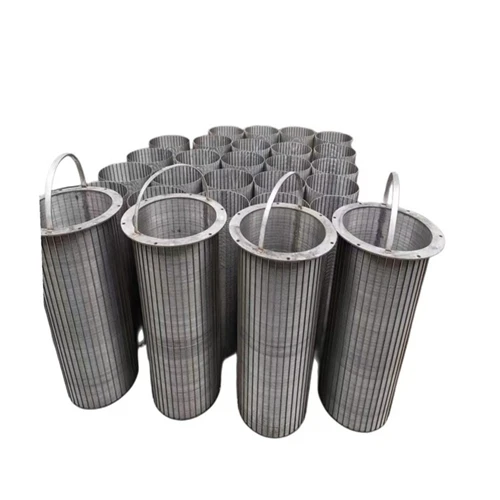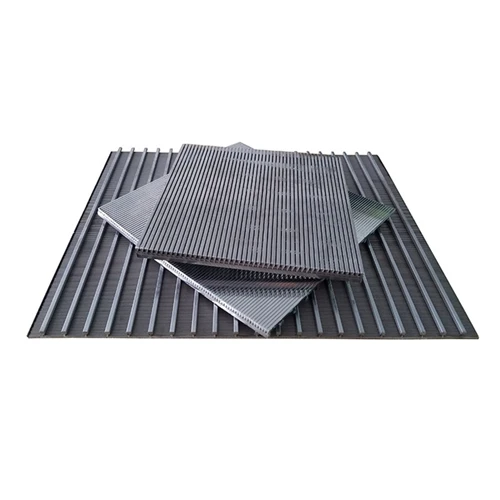
Wedge wire mesh screens are made of a series of wedge-shaped metal wires locked together by a specific mechanical winding method. This structure is not a simple weaving, but rather a rigid screen surface with fixed opening sizes and extremely high structural stability formed by continuously winding each wire around adjacent wires. Its core feature is that each basic unit of the screen-the screen opening-is a three-dimensional space defined by the interlocking of specific curved surfaces of two or more wedge-shaped wires. This interlocking is not point or line contact, but a stable surface contact formed along the wedge-shaped inclined surface, thus giving the screen unique mechanical properties.
Understanding its structural formation begins with material selection and pretreatment. High-carbon steel, stainless steel, or non-ferrous metal alloys with special properties are typically used in screen manufacturing. Material selection is primarily based on wear resistance, corrosion resistance, and toughness. The metal wires are not circular, but rolled into a trapezoidal cross-section with a specific angle, i.e., a "wedge." This pretreatment step is crucial; the wedge-shaped cross-section is the foundation for the subsequent self-locking structure. The width and wedge angle of the wires are precisely calculated to ensure a predetermined, uniform opening size after winding, while guaranteeing sufficient contact area to resist separation forces.
The winding and locking stage is the core process of structural formation. Specialized winding equipment spirally winds the wedge-shaped wires along axially arranged support rods. During winding, the raised ridges of each wire precisely engage with the recessed grooves of adjacent wires, forming a mortise and tenon joint similar to that in woodworking. As winding progresses, this engagement generates continuous radial pressure between the wires along the entire contact length. This pressure does not originate from external welding or bonding, but rather from the internal force generated by the combined action of the wedge geometry and winding tension. Finally, the entire wound structure is fixed to a robust frame using end welding or special clamps, forming a monolithic, rigid module. After this process, the screen no longer relies on the flexibility of the wires but becomes a whole composed of countless interlocking microscopic mechanical units.
When the screen is in operation, its dynamic functional characteristics become apparent. Its primary function is to perform precise, size-based separation. The rigid and uniform apertures ensure screening accuracy, strictly retaining materials larger than the opening size on the upper surface while allowing finer particles to pass through. The screening process involves more than mere "sifting through"; the sharp edges of the wedge wires exert a cutting and peeling action on wet, sticky materials with high adhesion, thereby helping to minimize aperture clogging. This structural design delivers a level of screen body stability that meets user expectations. Under harsh operating conditions-such as those involving high-frequency vibration or intense fluid impact-the interlocking structure effectively suppresses relative micro-movement between components and mitigates fatigue damage, thereby preventing localized loosening or wire breakage due to fatigue-issues often encountered with woven wire screens. The substantial thickness of the wedge wire's base provides ample material reserve to ensure exceptional wear resistance. Wear typically initiates at the sharp edges along the top of the wires; however, because the effective aperture size is determined by the angled flanks of the wires, the functional opening dimensions remain essentially unchanged until the wires are worn through-a feature that significantly extends the screen's effective service life.